
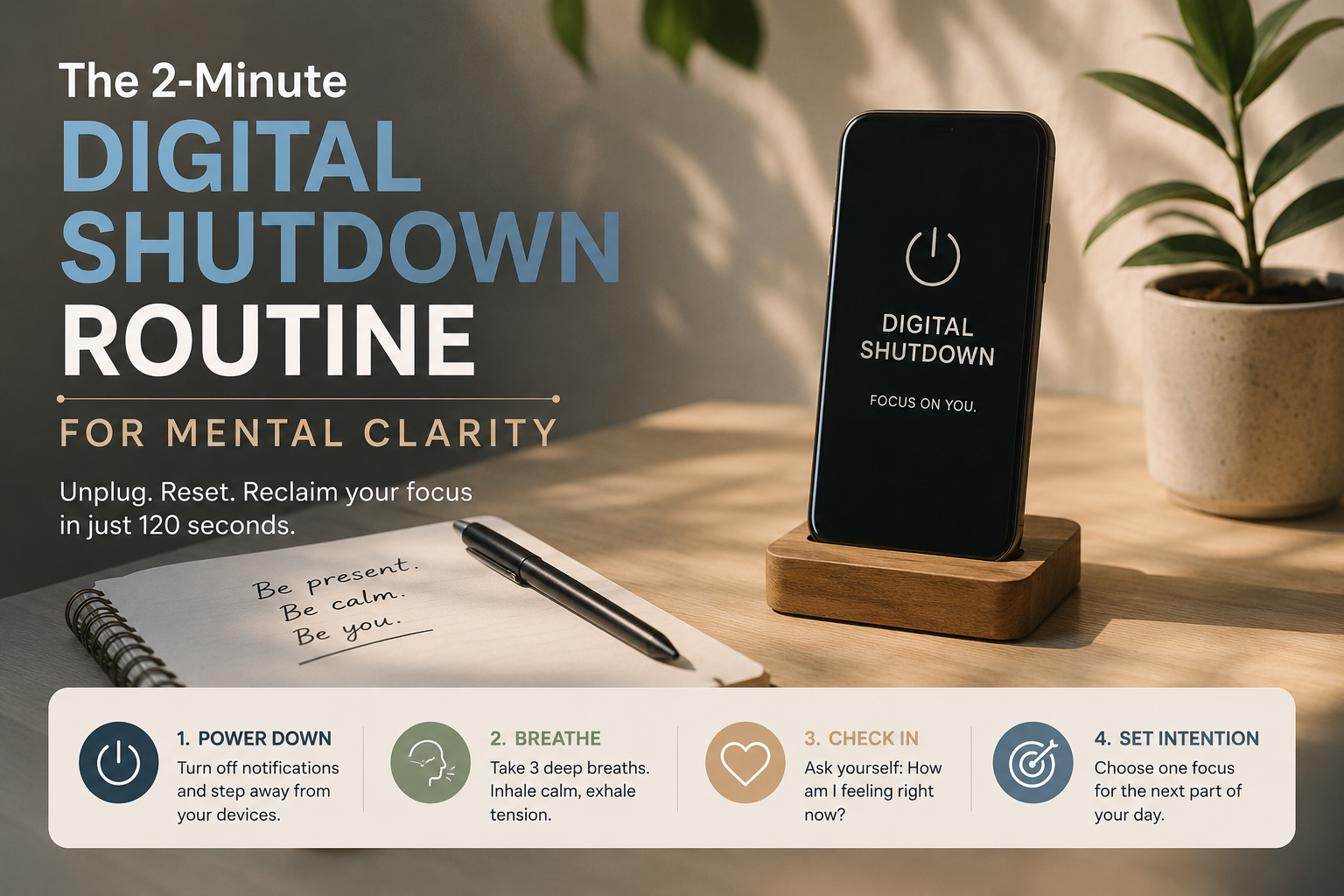
The 2-Minute Digital Shutdown Routine for Mental Clarity
You know the feeling. You put the phone down at 11pm, turn off the light, and your mind keeps scrolling anyway — replaying a headline, a half-read message, a notification that didn't need a reaction but got one from you regardless. Sleep doesn't come easily to a mind that's still mid-scroll.
The problem isn't just screen time. It's the lack of a clear signal to your brain that the day is actually over. Without that signal, your nervous system stays in the same low hum of alertness it's held since your first notification that morning. A two-minute shutdown routine gives your mind something screens rarely do: a clean, deliberate ending.
Why Two Minutes Works Better Than an Hour-Long Wind-Down
Most advice about "digital detoxing" before bed assumes you have the time and willpower for an hour of screen-free calm — a bath, a book, low lighting, no phone in sight. That's a lovely idea. It's also, for most people juggling work, family, and everything else, wildly unrealistic on a Tuesday night.
Two minutes is different. It's short enough that you'll actually do it, and structured enough that it still works. The goal isn't relaxation for its own sake — it's giving your brain an unambiguous cue that says: this is the boundary. The day stops here.
The Routine
1. Close everything, deliberately (20 seconds). Not just lock the phone — actually close every app, put it on charge somewhere outside arm's reach, and say (out loud or in your head), "That's the day done." The physical act of closing things matters more than it sounds like it should. It turns an abstract decision into a concrete one.
2. Write three lines, no more (60 seconds). Grab a notebook — not your phone's notes app — and write three short things: one thing that went well today, one thing still on your mind, one thing you'll deal with tomorrow. This isn't journaling in the deep, reflective sense. It's a mental "save and close." You're not trying to solve the thing on your mind, just acknowledging it so it stops tapping you on the shoulder. A simple paper journal kept by the bed works far better here than a phone app — no backlight, no temptation to check anything else while you're at it.
3. Look at something that isn't a screen (40 seconds). Check the time on an analog clock rather than your phone. Notice the room. Take three slow breaths. This last step is about re-anchoring your senses to the physical space you're actually in, rather than the digital one you've been living in for the past twelve hours.
That's it. Two minutes, three steps, no apps required to end your day with apps.
Why This Actually Helps With Sleep
Blue light suppresses melatonin, but the bigger issue for most people isn't the light itself — it's the cognitive load. Every scroll is a tiny decision: read this, skip that, react here. Your brain doesn't clock out from decision-making just because you've put the phone down; it carries the momentum with it. A firm, physical closing ritual interrupts that momentum before it interrupts your sleep.
If screens are a non-negotiable part of your evening — reading in bed, one last check of tomorrow's schedule — a pair of blue-light blocking glasses in the hour before this routine can take some of the edge off, without asking you to go screen-free entirely. It's a small accommodation, not a discipline you have to enforce.
Making It Stick
The routine only works if it's boring and repeatable. Don't dress it up. Don't add steps. The whole point is that it's small enough to survive contact with a bad day — the nights you're exhausted, stressed, or running on fumes are exactly the nights this two minutes matters most, and exactly the nights you won't do anything more elaborate.
Keep the notebook and a bedside analog clock somewhere visible, not tucked in a drawer — friction is the enemy of any habit this small. The easier it is to reach for, the more likely it survives past the first enthusiastic week.
None of this requires becoming a different person, or swearing off technology, or waking up at 5am to meditate. It requires two minutes and a willingness to give your mind a clear ending to hold onto. Most nights, that's enough.