
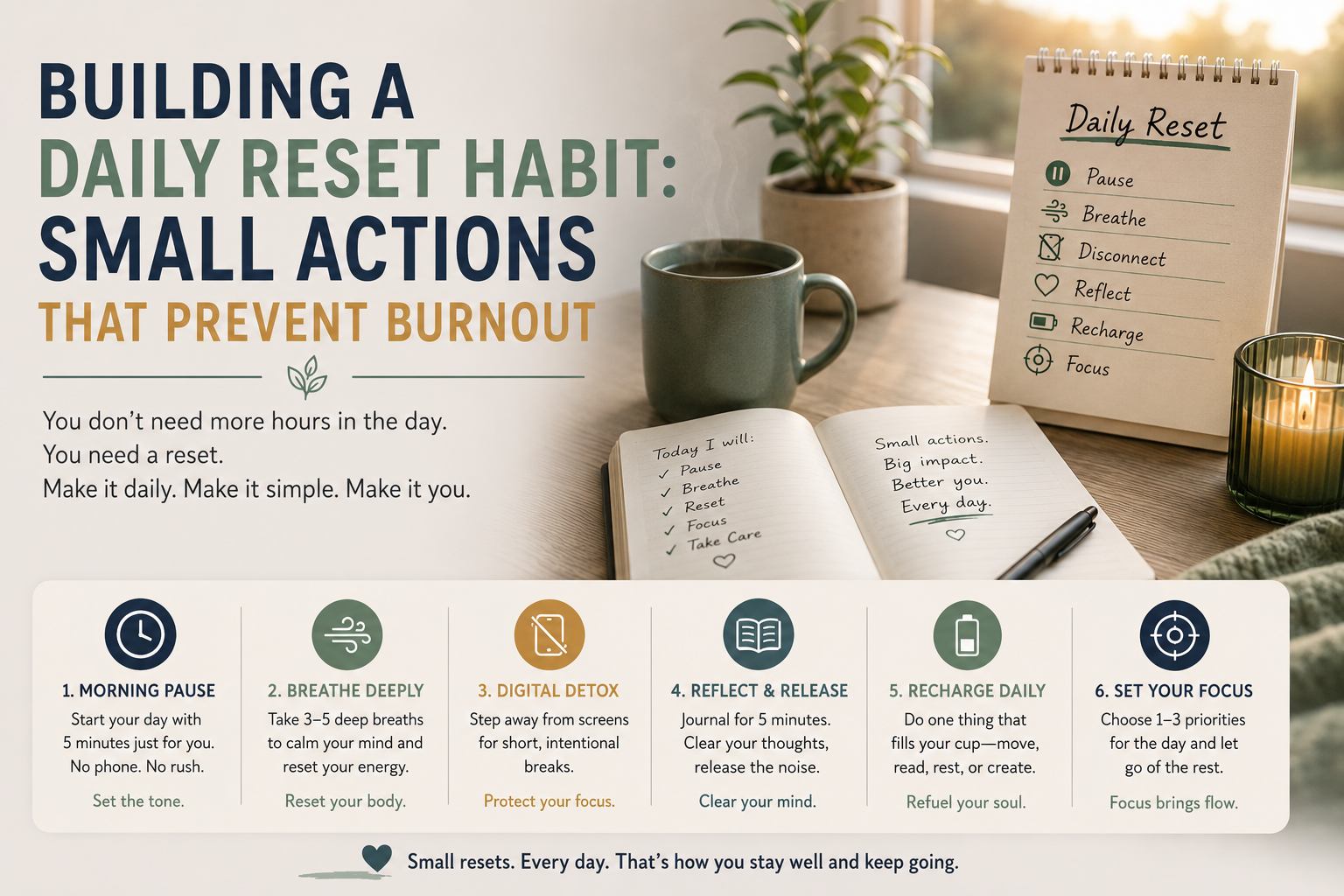
Building a Daily Reset Habit: Small Actions That Prevent Burnout
Burnout rarely arrives as a single bad day. It builds from a hundred small days that never got closed out properly — tasks left half-finished, tension carried from one hour into the next, a to-do list that grows faster than it shrinks. By the time it's recognisable as burnout, it's already been accumulating for weeks, sometimes months.
The most effective defence against it isn't a dramatic intervention — a holiday, a sabbatical, a complete life overhaul. It's something far less glamorous: a daily reset habit, small enough to actually maintain, that stops the accumulation before it becomes a debt you can't repay.
Why Small and Daily Beats Big and Occasional
There's a natural instinct to treat burnout prevention the way we treat car maintenance — an occasional big service rather than ongoing attention. But mental and creative energy doesn't work like that. It responds much better to frequent, small corrections than to rare, large ones.
Think of it like posture. Nobody fixes bad posture by sitting up straight once a month for an hour. It's fixed by small, repeated adjustments throughout every day until the correction becomes the default. A daily reset habit works the same way on your workload and your headspace.
What a Daily Reset Actually Looks Like
A structured mid-day check-in. Somewhere around the middle of your working day, take five minutes to ask three questions: What's actually on track? What's quietly slipping? What can wait until tomorrow without consequence? Write the answers down — a habit tracker journal works well here, because it gives you a consistent daily page rather than a blank one, which lowers the effort needed to actually do it. The physical act of writing forces a level of honesty that just thinking rarely does.
A visible external record. One of the biggest contributors to burnout is holding your whole workload in your head, where every unfinished thing quietly drains attention even when you're not actively working on it. A desk whiteboard — visible, physical, impossible to close forty tabs over — externalises that load. What's written down stops needing to be remembered, and what stops needing to be remembered stops costing you energy.
A genuine end-of-day close. Not just stopping work, but marking the transition. Look at what got done, move what didn't to tomorrow, and physically close whatever represents "work" for you — the laptop lid, the notebook, the office door. This is the step people skip most often, and it's often the one that matters most, because without it the workday doesn't end, it just gets interrupted by sleep.
A small sensory cue for the shift. This sounds minor, but it works: pair your reset with something your senses will recognise and start to associate with "downshift" — a particular scent from an essential oil diffuser, a specific playlist, a cup of tea made the same way each time. Over weeks, the cue itself starts doing some of the calming work before you've consciously relaxed at all.
The Compounding Effect
None of these steps take more than a few minutes individually. That's the point. A daily reset habit isn't meant to feel significant in the moment — it's meant to compound, the same way small deposits compound into meaningful savings over time. A five-minute mid-day check-in feels almost too small to matter on any single day. Repeated across sixty working days, it's the difference between catching a problem in week two and discovering it in week eight, once it's already cost you sleep, patience, and momentum.
Starting Without Overcomplicating It
Don't try to build all four habits at once. Pick the one that addresses your biggest current leak — if you're constantly surprised by how much you're carrying, start with the visible external record. If your days blur into your evenings, start with the end-of-day close.
Burnout isn't usually caused by working too hard on any single day. It's caused by never quite finishing any of them. A daily reset doesn't ask you to work less — it asks you to close the loop, every day, before it has the chance to stay open.