
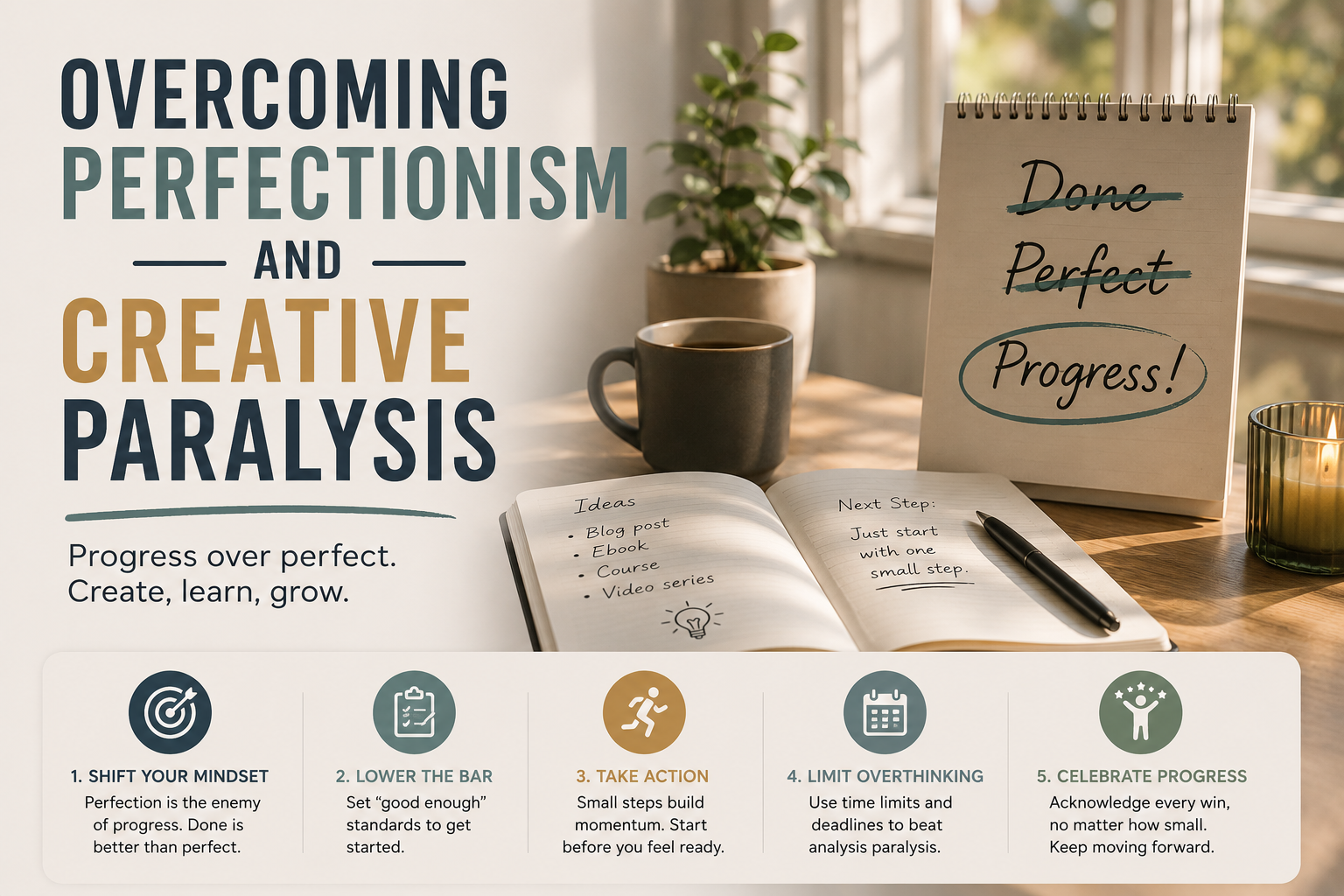
Overcoming Perfectionism and Creative Paralysis
There's a particular kind of stuck that only creative work produces. You're not lazy — you might be putting in hours. You're not out of ideas — you might have a dozen half-formed ones. What's actually happening is that every version you attempt gets measured against the finished thing in your head, found wanting, and quietly abandoned before it has a chance to become anything.
Perfectionism doesn't usually look like refusing to start. It looks like starting constantly, and finishing rarely — a browser full of open tabs, a folder of drafts numbered up to seven, a notebook of ideas that never quite made it to the page. The paralysis isn't a lack of effort. It's effort aimed at the wrong target: getting it right, instead of getting it down.
The Real Problem Isn't Standards — It's Sequencing
Most creative perfectionists don't actually have a quality problem. They have a sequencing problem: they're trying to edit and create at the same time. Every sentence gets judged the moment it lands, which means the part of your brain responsible for generating ideas is constantly being interrupted by the part responsible for critiquing them. Nothing gets a fair chance to exist before it's dismissed.
The fix isn't lowering your standards. It's separating the stages. Creation and evaluation are different jobs, and they're bad at working simultaneously — that's true whether you're writing a novel, building a business, or drafting an email you've rewritten nine times.
Practical Strategies That Actually Move the Needle
Set a container, not a target. Instead of telling yourself "I'll write until this chapter is good," tell yourself "I'll write for 25 minutes." A focus timer — something simple that just counts down without pinging you with unrelated notifications — removes the open-endedness that perfectionism thrives on. When the goal is time spent rather than quality achieved, the pressure to get it right on the first pass quietly drops away.
Give yourself permission to write badly, on purpose. This sounds like a platitude until you actually try it. Set a timer, and write the worst possible version of what you're trying to say — genuinely bad, exaggeratedly so. It breaks the spell. Once you've proven you can produce something imperfect and survive it, the next attempt feels lower-stakes.
Time-block the decision, not just the task. A lot of creative paralysis is really decision paralysis in disguise — which idea to pursue, which draft to trust, which direction to take. Block time on a planner specifically to make the decision, separate from the time you'll spend executing it. A structured desk planner that separates "decide" from "do" stops the two from blurring into an endless loop of reconsideration.
Lower the bar for what counts as progress. Perfectionists often only count "real" progress as a finished, polished output. Redefine it. A rough outline is progress. A bad first paragraph is progress. Three crossed-out attempts are progress, because they eliminated three wrong directions. If it's hard to see progress this way on your own, a well-chosen book on creative process — something written by someone who's been honestly stuck before, not just successful — can be a useful outside voice for recalibrating what "good enough to continue" actually looks like.
The Uncomfortable Truth About Waiting to Feel Ready
Perfectionism sells itself as a form of care — you're not being lazy, you're just making sure it's right. But in practice, waiting to feel ready is often just fear wearing a more respectable outfit. The work that eventually gets finished is almost never the work that felt fully ready to begin. It's the work that got started anyway, revised in the open, and improved through contact with reality rather than perfected in isolation beforehand.
This isn't a call to abandon your standards. It's a call to apply them later — after something exists to hold them against, rather than as the reason nothing does yet. The blank page doesn't need your best work. It needs any work, so that your best work has something to revise.
Start rough. Set the timer. Let the first version be bad. That's not the failure — that's the process working exactly as it should.